Services for schools
Creating schools where all children, young people and staff can thrive

“The content was amazing. Made me want to know more.”
“Thank you so much for the training, it was really engaging and I found the training really enjoyable.”
We know every school’s needs are different, so we offer a range of ways to get support. We help your staff understand trauma, neurodivergence and behaviour in context, tailored to your school.
Consultations and commissioned training for schools
Support planning, school observations, feedback from assessments, and hands-on strategies you can use straightaway in the classroom.
School observations
A member of our therapy team visits the child or young person in their own school setting, observing them in structured time (a lesson) and unstructured time (break or lunch), along with a short meeting with their teacher or SENCO.
This gives our therapists a genuine, first-hand understanding of how the child is managing day-to-day in school, so the areas that matter most can be built into their sessions with us. The visit concludes with a detailed report.
Resources and ongoing professional development
Building lasting understanding and capacity across your whole setting, not just one training day.
Bespoke training
Our training is always tailored to your school, but topics we’re regularly asked to cover include:
- Supporting Attachment, Cognitive Functioning and Emotinoal Wellbeing
- Understanding trauma and its impact on learning and behaviour
- Neurodiversity Affirming Teaching
- Stress Management & Wellbeing for Staff
- Sensory processing and regulation strategies for teaching staff
- Using assessment findings to inform everyday classroom practice
Sessions can be delivered as a single training session, a rolling programme, or blended with consultation and case-based support – get in touch to build a package around your school’s needs.
Assessments and therapy for children in your school
Our specialist team offer a range of assessments which parents can book directly, with no waiting list. From initial screening to diagnostic assessments, we help work out next steps and provide reports to support a wide range of needs and EHCPs (Education, Health and Care Plans). Our services include:
Screening assessment and consultation, Autism assessment, ADHD assessment, Sensory Integration assessment, Occupational Therapy assessment, Attachment assessment (using Theraplay MIM), handwriting assessment, creative arts therapies, talking therapies, occupational therapy and Sensory Integration therapy. See our assessments page and therapy pages for details.
Why choose Family Futures?
Family Futures is a UK-based provider of therapeutic support, specialist assessment and multidisciplinary intervention for children who have experienced trauma, attachment disruption, loss or chronic early adversity – and for children whose brains and nervous systems are simply wired differently. Our team includes clinical psychologists, psychotherapists, occupational therapists, specialist teachers and trauma-informed practitioners, and we work directly with schools to help make sense of behaviour and give staff practical, workable ways forward.
We’re a centre of excellence, consistently rated Outstanding by Ofsted, and we offer everything from a single staff training session to supportive consultation sessions. We also offer full assessment and therapy programmes built around an individual child.
Neurodiversity and trauma specialists
Many children we support are neurodivergent or process sensory information differently – sometimes alongside a trauma history.
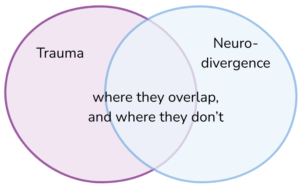
A child who is dysregulated because of past adversity and a child who is dysregulated because their nervous system processes the world differently can look very similar in the classroom, but they need different kinds of support. We take a neuro-affirming approach throughout, seeing neurodivergent traits as strengths, not things to be corrected. Our focus is on understanding each child’s unique needs, building safety and connection with supporting adults and peers in their lives.
Our approach: Neuro Physiological Psychotherapy
Over the past 28 years we’ve developed our own therapeutic and evidence-based model, Neuro Physiological Psychotherapy (NPP). It is grounded in research and years of direct clinical work with families. NPP works with the nervous system, the child’s relationships, and their thinking and coping skills together.
For children who’ve experienced complex trauma, or whose nervous systems are wired differently, what looks like “bad behaviour” is very often a sign of a nervous system in survival mode, or of a child who is overwhelmed, overstimulated, or trying to self-regulate in the only way they currently know how. In that state, a child genuinely can’t access the focus, patience or social bandwidth that classroom life demands.
Our holistic approach helps children engage with their learning, with their peers, and with their teachers. Our specialist team bring decades of hands-on clinical experience and a deep understanding of how trauma and neurodivergence show up in the classroom.
Our evidence based approach
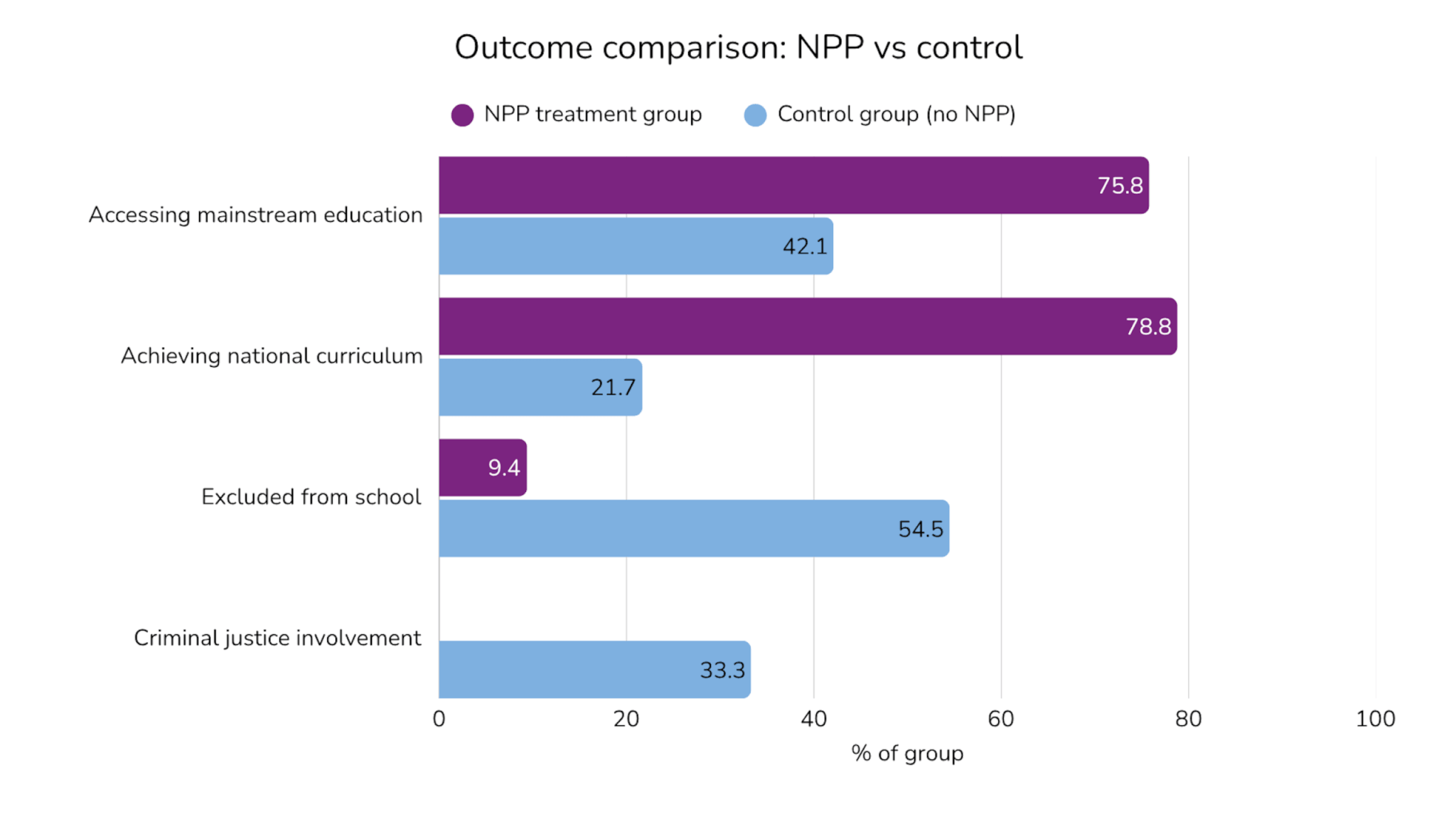
Our research evaluation (2019) compared children who received the full NPP therapy programme at Family Futures with a similar group of children who didn’t. The differences were significant, and they matter for exactly the outcomes schools care about:
- Behaviour and self-regulation: children who received NPP showed significantly greater improvement in self-regulation and executive functioning. The skills behind classroom engagement, focus and planning ahead.
- Externalising behaviour: NPP was linked to significant reductions in the kind of dysregulated behaviour, including aggression and impulsivity, that most often leads to exclusion.
- Staying in school: permanent exclusion rates were far lower in the NPP group – 9.4%, compared with 54.5% in the control group.
- Attainment: children who received NPP were much more likely to meet National Curriculum expectations (78.8% vs 21.7%) and to stay in mainstream education (75.8% vs 42.1%). That’s not just calmer behaviour but also it’s real learning taking place.
School Resources and Information
- Trauma-informed and neuro-affirming support in schools: Find out ways to interpret behaviour and create inclusive classrooms, backed by research
- Attachment, Developmental Trauma and Executive Functioning Difficulties in the School Setting: A handbook for teaching adopted and Looked After Children
- Education, executive functioning and neuro-affirming practice: Explore how educational psychotherapy and strengths-based, neuro-affirming practice help children and families by shifting focus from “fixing” individuals to creating supportive environments.
- Pondering Pods, understanding EHCPs: Insights to help you advocate for the support your child or young person deserves.
- Selfcare sessions, body tracking (resourcing your nervous system): A somatic experience body tracking session